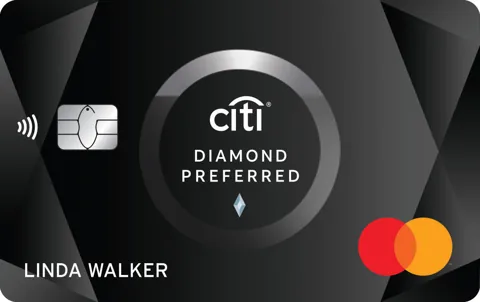
Citi Diamond Preferred: $144 to move $4,800 for 21 months, in Julia's example
A no-annual-fee card built for repaying a balance, not for rewards: 21 months at 0% costs a 3% fee, but a late payment can end the offer.
The short answer
Citi Diamond Preferred is a no-annual-fee card with an introductory interest offer, aimed at giving you time to repay eligible debt rather than earning shopping rewards. Eligible balance transfers get 21 months at 0% from account opening. Julia turns that long period into a monthly payment that fits her budget, then checks what could get in the way.
In her example, a $4,800 transfer with a 3% fee of $144 makes a $4,944 balance. At $240 a month, 20 payments cover $4,800 and payment 21 clears the last $144, so the fee is her entire financing cost if she transfers promptly and the payments fit the promotional calendar. Leaving the debt at a constant 24% would take about 26 payments and about $1,391 of interest.
The Studio gives it a Financing Wallet Score of 81 out of 100. Its fit note reads, "A fixed payoff plan fits the promotional period and available approved limit." It suits a household with an eligible balance on a non-Citi account and a payment it can keep to the finish without ever paying late. It fits less well one that needs a much smaller payment, whose debt is on a Citi account, or that wants rewards.
What it costs
There is no annual fee. Complete a transfer within the first 4 months to qualify for the promotional transfer rate. The fee in that window is 3%, with a minimum of $5, and afterward it is 5% with the same minimum. Both introductory clocks start at account opening, and once a promotion ends, the remaining balance gets the regular variable APR in your terms.
Julia compares the offer with keeping the debt where it is, and with other eligible offers by total fees and interest. A shorter promotion might be enough, and another 21-month offer with a higher fee might add nothing useful to her plan.
What it earns
Diamond Preferred does not earn rewards, so Julia judges it by how well it helps her repay the existing balance. She would not need it to become her everyday shopping card afterward.
Its other features are free FICO score access and Citi Entertainment access to eligible ticket sales. Neither changes the $144 fee or makes the payment more affordable. Julia would be pleased if her score improved while she paid down debt, but she would not assume a particular increase or buy event tickets to use the card more.
The Studio's Financing Wallet Score gives 60 points to full borrowing cost, 20 to payoff room, and 10 each to late-payment rules and setup time. Its shared test uses a $5,000 transfer at $250 monthly and a separate $1,200 purchase at $100. The low transfer fee and long transfer offer earn 51 of 60 cost points and all 20 payoff-room points, but the late fee and possible penalty APR cost it all 10 late-payment points.
The credits, used honestly
This card's benefit is time, and the two clocks differ. Transfers get 21 months, but purchases get only 12 introductory months from account opening.
Suppose a $600 repair bill arrived in month 11 of the payoff. It would not get the same interest-free time as the transfer: the repair would get only the time remaining. When the purchase offer ended, that balance could start charging interest while the transfer still had promotional time left. Carrying the transfer can also affect the purchase grace period, and paying an amount equal to the repair bill might not restore interest-free treatment.
Julia keeps new spending off the transfer card. If the repair needed financing, she would give it a separate calculation and make sure the combined monthly payments fit her budget. She records the purchase deadline and the transfer deadline separately.
The catch
Citi's terms say a late payment can end the introductory APR and bring in a penalty rate, so Julia does not treat the 21 months as unconditional. She sets automatic minimum payments as a backup, arranges her larger payment and keeps checking statements for an unexpected new charge or a transfer that did not happen as planned. She also writes down the actual expiration dates from the account documents.
Check the bank behind your debt. Citi excludes transfers from Citi-issued accounts and its affiliates, and some store cards are Citi accounts even when the store name gets all the attention. Then check how much available credit you need for both the transfer and its fee: approval does not ensure the entire transfer will be approved.
Keep paying the original lender until the transfer is confirmed: Citi's process includes a waiting period for a newly opened account plus processing time, and a request has not paid the old bill. If some debt stays behind, both accounts still need payments.
If repayment runs past the offer, the regular rate generally starts on the remaining balance. A store's deferred-interest offer can instead charge interest tied to the original purchase date if you miss the full-payoff deadline, so read the actual language. The Studio's limitation note reads, "Financing-only score; approval, transfer capacity and future personal APR are not predicted."
Who it fits
It fits a household that can pay $240 a month toward an eligible $4,800 balance on a non-Citi account, finishing at payment 21, or $260 a month if that is comfortable and does not push groceries onto another expensive card. Julia would choose between those payments based on the rest of her budget.
It fits less well a household that could manage only $180 a month, which would still leave $1,164 when the offer ended, or one that needs to finance a new expense on the same card. Julia would not automatically rule out the transfer even then: she would estimate the interest after the promotion and compare the full cost with other options at that same $180 payment.
The arithmetic
Julia's example moves $4,800 from another issuer's card.
- Fee and balance: 3% of $4,800 is $144, so the new balance is $4,944.
- At $240 a month: 20 payments cover $4,800 and payment 21 clears the last $144, a financing cost of $144.
- At $260 a month: 19 payments cover $4,940, leaving $4 for payment 20.
- Doing nothing: $4,800 at a constant 24% takes about 26 payments of $240, and a simplified monthly model puts the interest at about $1,391.
- At $180 a month: 21 payments reduce the balance by $3,780, leaving $1,164 when the offer ends, and the regular rate would begin on that amount.
The actual interest depends on daily balances and payment dates, so Julia would use her real account terms.
Before you apply
Check Citi's terms for the 21 months, the 4-month transfer window, the 3% and 5% fees with their $5 minimum, the 12-month purchase period, the regular APR and the late-payment rules, along with who issued your old card.
The Studio checked these terms on October 6, 2026, so they may have moved since the video. The $4,800 balance and the $240 payment are Julia's assumptions, and the Studio's own test assumes a 30% rate after the promotion.
Rewritten from Julia’s review script (1,211 words); every figure traces to the script or this card’s record. Terms checked Oct 6, 2026.