Delta Platinum Business: $52.80 ahead of a 2% card in Julia's example
A $350 card that depends on a usable companion certificate: $52.80 ahead in Julia's two-person example, $2.80 if rewards are given up for status.
The short answer
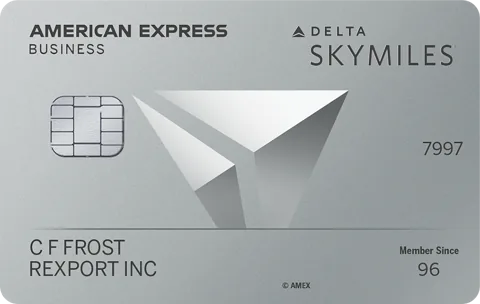
The Delta SkyMiles Platinum Business American Express Card combines airline miles with a renewal companion certificate, selected credits and Medallion qualification benefits. It costs $350 a year. Julia would consider it if her business already made regular Delta trips, because a large spending budget alone would not make it useful.
In her example, a two-person trip on the companion certificate saves $219.40 and a prepaid Delta Stays hotel saves $183.40 more. After the $350 fee she finishes $52.80 ahead of a no-fee 2% card on those bookings, a small margin. Moving a $10,000 equipment purchase onto the card to gain status progress would cost $50 in rewards and leave $2.80.
The Studio gives it a Business Wallet Score of 47 out of 100. Its fit note reads, "Businesses with recurring eligible Delta trips." It suits a business that regularly needs two people on an eligible Delta trip. It fits less well one that travels alone or cannot use the certificate on its work dates.
What it costs
The annual fee is $350. Julia first compares the card with a no-fee 2% business card, assuming carry-on travel and payment without interest. She also asks what Delta Gold Business would do for the same trips: Platinum's recurring fee is $200 higher, and some bag and award-discount benefits overlap, so she cannot count them again as reasons to pay the difference.
That leaves the usable companion certificate, the additional hotel-credit allowance and status progress to justify the gap. Julia also does not rely on a welcome bonus repeating at renewal.
What it earns
- 3 miles per dollar on eligible direct Delta purchases, and on eligible Delta Stays hotel charges under the current terms.
- 1.5 miles per dollar on eligible transit, U.S. shipping and single eligible purchases of at least $5,000. These categories share a cap of $100,000 each calendar year.
- 1 mile per dollar on other ordinary purchases.
Higher rates do not stack, so a qualifying direct Delta or hotel purchase earns its 3 miles instead. If a supplier splits an order into smaller charges, the large-purchase rate may not apply, and a supplier surcharge could cost more than the rewards. The Studio's rate card values a mile at 1 cent, the same value Julia uses.
The card's annual head start supplies 2,500 Medallion Qualification Dollars (MQDs), and eligible card purchases earn 1 MQD for every $20. MQDs are not redeemable miles: they measure progress toward a status tier, and 500 of them cannot take $500 off a flight. Returned purchases reduce progress and late-year processing can change which year receives it, so Julia leaves time to verify them.
The credits, used honestly
The companion certificate covers qualifying Delta Main round trips on eligible U.S., Mexico, Caribbean and Central American routes after renewal. Delta Basic is not eligible, and the required fare classes may be unavailable even when a flight has seats for sale. You book together in the same reservation and cabin, pay with the eligible Delta Platinum card and/or permitted eCredits, and finish the travel before the certificate expires.
Taxes and fees remain, up to $80 domestically or $250 internationally on eligible itineraries of up to 4 segments. Julia also checks advance-booking and stay rules, because a certificate that needs an extra hotel night can make a short work trip more expensive. The companion earns no flight miles or MQDs, so she keeps flight-earned miles out of the comparison and checks that difference alongside the final fare.
The hotel credit is up to $200 each calendar year on qualifying prepaid Delta Stays hotels or vacation rentals paid with the card.
Eligible first bags can be waived for the basic cardholder and up to 8 companions on the same reservation, and the domestic second-bag waiver is for qualifying basic cardholders. You include the SkyMiles number and use the card for the tickets; if status or the fare already covered the bags, there is no further saving.
There is no lounge access. The card offers TakeOff 15 on eligible Delta awards, with taxes paid on the eligible card, and enrolled monthly Resy and selected U.S. rideshare credits of up to $10 each; unused amounts do not help the calculation.
The Studio's rate card carries the hotel credit at up to $200, the Resy credit at up to $120 and bag savings at up to $240, and flags them for a check on the issuer's page.
The catch
Everything depends on the certificate being available when you travel. Julia wants actual certificate availability and hotel price to support the result before she relies on it.
Status is a separate decision. Suppose the account is still 500 MQDs short after expected travel, existing card purchases and the head start: another $10,000 of eligible purchases would earn them. A single eligible $10,000 equipment purchase earns 15,000 miles, worth $150 at 1 cent, while a 2% card earns $200. Moving it costs $50 in rewards and nearly uses up the $52.80 advantage, leaving $2.80 before any value for status.
Julia first asks whether the business already needed the purchase, then what rewards she would give up, and whether the tier's extra benefits would matter to her coming trips. Reaching a number on the account is not enough by itself.
The Studio's limitation note says most spend earns modest miles and that fit depends on eligible Delta routes, credits and a usable companion certificate. Its shared travel plan has one traveler, so the certificate saves nothing there, and it leaves status out of the cash total.
Who it fits
It fits a business that regularly needs two people on an eligible trip, like Julia and a partner attending a training event with $300 tickets, and that would also book Delta Stays hotels. Julia prices that booking first, then decides separately whether spending toward status is worth the rewards given up.
It fits less well a business that travels alone, because the certificate would save nothing, or one that cannot use the certificate on work dates. If those are your cases, the lower-fee Gold Business card might handle the important parts just as well. It also fits less well one that wants lounge access.
The arithmetic
Julia's example is a training event for her and a business partner. Suitable tickets cost $300 each, or $600 together, they travel with carry-ons and pay without interest.
- Tickets without the certificate: $600 on a no-fee 2% card earns $12, a net cost of $588.
- Tickets with the certificate: a $340 primary fare plus $40 of companion taxes and fees is $380. At 3 miles per dollar it earns 1,140 miles, worth $11.40, a net $368.60.
- Ticket saving: $588 less $368.60 is $219.40, leaving $130.60 of the $350 fee to justify.
- Hotel: a $280 direct booking on the 2% card costs $274.40 after rewards. With equivalent cancellation terms, the $300 Delta Stays price earns 900 miles worth $9 and, after the $200 credit, costs $91, a saving of $183.40.
- Result: $219.40 plus $183.40 less the $350 fee leaves $52.80 ahead.
- Status: moving a $10,000 equipment purchase costs $50 in rewards, which leaves $2.80 before valuing status.
Before you apply
On Amex's page, check the annual fee, the certificate's routes, fare classes, expiry and taxes-and-fees limits, the hotel credit, the earning rates and the $100,000 cap, and how the card counts MQDs. Julia chooses the card around the trips and bookings first, and uses only purchases the business could already afford.
The Studio checked these terms on October 6, 2026, so they may have moved since the video. The $300 tickets, the $280 hotel and the 1-cent mile are Julia's assumptions to replace with your own.
Rewritten from Julia’s review script (1,324 words); every figure traces to the script or this card’s record. Terms checked Oct 6, 2026.