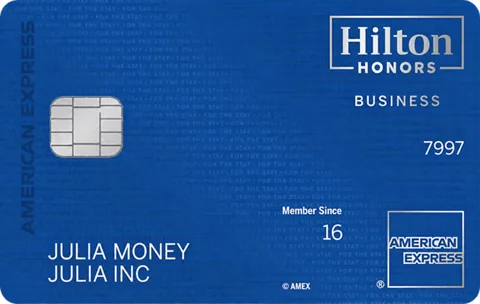
Hilton Honors Business: $141 ahead of 2% cash back in Julia's example
Earns 5 Hilton points per dollar for a $195 fee; it led 2% cash back by $141 in Julia's example, but only for a business that books Hilton stays.
The short answer
The Hilton Honors American Express Business Card earns Hilton points on eligible business purchases, includes Gold status and adds quarterly Hilton credits. The annual fee is $195. Julia's question is whether those rewards are useful enough to choose over plain cash back.
In her example, a business with $24,000 of eligible non-Hilton purchases and three planned Hilton stays finishes $141 ahead of a no-fee 2% card. That values each point at 0.5 cent. At 0.4 cent the lead falls to $10.20. With all three stays in one quarter, at 0.5 cent, it falls to $21.
The Studio gives it a Business Wallet Score of 56 out of 100. Its fit note reads, "Businesses repeatedly staying with Hilton and using quarterly credits." It suits a business whose work already takes it to Hilton hotels a few times a year, in different quarters. It fits less well one that would pick a hotel mainly to use the card, or that values the flexibility of cash.
What it costs
The annual fee is $195. Julia compares the card with a business card that has no annual fee and earns 2% in cash, using the same work expenses, with no welcome bonus and no interest charges.
The extra points on everyday purchases do not cover the fee: in her example Hilton adds only $120 over the 2% card before the fee. The quarterly credits and the higher hotel rate have to make up the rest.
An opening offer, including any introductory Free Night Reward, belongs in the first-year decision. Julia does not repeat it in every renewal calculation, and this article leaves it out.
What it earns
- 5 Hilton points per dollar on the first $100,000 of eligible non-Hilton purchases each calendar year.
- 3 points per dollar after that.
- 12 points per dollar on eligible direct Hilton purchases.
On $24,000 of eligible non-Hilton purchases the card earns 120,000 points. At 0.5 cent each, used on hotel stays Julia would otherwise buy, that is $600 of travel value, against $480 in cash from a 2% card.
Three stays at $300 each make $900 of eligible hotel charges. At 12 points per dollar they earn 10,800 points, worth $54 at her value, against $18 on the 2% card.
The Studio's rate card values a Hilton point at 0.4 cent, below Julia's 0.5 cent. She bases the value on the cash hotel she would otherwise book, after taxes, mandatory charges and rewards forgone, so a high listing price at a hotel she would not choose proves nothing. These are Hilton points, not Membership Rewards points you can automatically send to Amex's airline partners.
The credits, used honestly
The Hilton credit is up to $60 per quarter, or $240 across the year. Three stays in three different calendar quarters could use $180. The fourth quarter has no stay, so Julia gives it no value and does not assume that more spending on another trip makes it available. The Studio's rate card carries the credit at $180, the largest of the amounts its test budgets use, and flags it for a check on the issuer's page.
The payment route decides whether a charge counts:
- Eligible reservations must be made through a Hilton-operated channel and charged directly by the property. Third-party travel-site bookings do not qualify.
- Eligible incidentals must be charged to the room and paid with this card at checkout. A restaurant inside a hotel may submit its own charge, so its location alone is not enough. Allow time for the credit to appear.
- Employees' eligible purchases can use the allowance, but the quarterly limit is shared by the account. It is not a separate $60 for each employee.
Julia gives Gold status no dollar value and adds no extra status points. It may help with eligible hotel benefits, but check the property and make any required selection: breakfast and food-and-beverage benefits vary by location, and an upgrade is not assured. Diamond status follows $40,000 of eligible calendar-year purchases, under the card's terms.
Gold also affects redemptions: eligible elite members get every fifth night free on a standard-room reward stay booked entirely with points. For a five-night stay, Julia compares the full award price with five paid nights and counts the benefit once, inside the redemption value. If you already hold eligible Hilton status, the card adds nothing here.
The catch
Julia would check a future booking before treating the whole balance like cash. Award availability and loyalty to one hotel program make the rewards less flexible, and the Studio's limitation note names "Variable hotel redemption and loyalty commitment" and adds that status has no fixed cash value.
Dates matter as much as trips. If the three stays all fall in one quarter, the total Hilton credit stops at $60. The number of trips stays the same while the dates change how useful the card is.
After $100,000 of eligible non-Hilton purchases the rate drops to 3 points. Another $20,000 of ordinary expenses would earn 60,000 points, worth $300 at 0.5 cent, while the 2% card earns $400. Leaving those expenses here gives up $100, so Julia would consider changing the payment card.
A supplier surcharge needs its own comparison: more points do not justify paying by card when the added fee exceeds what you earn. Price also comes before the benefit. If a suitable hotel closer to the client costs less, Julia compares the full stay after rewards and transport, and she would not add commuting time just to use a credit. The account is for genuine business expenses, paid on time.
Who it fits
It fits a business like Julia's example: $24,000 of eligible non-Hilton purchases, three qualifying Hilton stays at $300 each in three different quarters, and points redeemed at about 0.5 cent on hotels it would book anyway.
It fits less well a business whose stays bunch into one quarter, whose work is not near suitable Hilton hotels, whose points would return only 0.4 cent, or whose ordinary spending would pass the $100,000 cap. Julia wants her actual work destinations and stay dates to support the choice before she counts on the attractive earning rate.
The arithmetic
Julia's example has $24,000 of eligible non-Hilton purchases, three Hilton stays at $300 each in three different quarters, no welcome bonus and no interest, with points valued at 0.5 cent.
- Purchases: 120,000 points are worth $600, against $480 on a 2% card.
- Hotel charges: $900 earns 10,800 points, worth $54, against $18.
- Points total: $600 plus $54 is $654.
- Credits and fee: three quarters at $60 add $180, and the $195 fee leaves $639.
- The 2% card: $480 plus $18 is $498 on the same $24,900.
- Result: $639 less $498 leaves Hilton $141 ahead.
At 0.4 cent per point the same points are worth $523.20, which becomes $508.20 after credits and the fee, or $10.20 more than the 2% card. With all three stays in one quarter at 0.5 cent, the credits fall by $120 and the lead is $21.
Before you apply
On Amex's page, check the annual fee, the earning rates and the $100,000 cap, the amount and conditions of the quarterly credit, and the terms for Gold and Diamond status. Julia would also check when the Hilton bills would arrive and how she would use the points; if those answers were uncertain, plain cash back would be an easy alternative.
The Studio checked these terms on October 6, 2026, so they may have moved since the video. The $24,000 of purchases, the three stays and the 0.5-cent value are assumptions to replace with your own.
Rewritten from Julia’s review script (1,314 words); every figure traces to the script or this card’s record. Terms checked Oct 6, 2026.